Five of the Best Attacking Rackets for 2026 — Compared by Hardness
Attacking rackets are not all the same. That sounds obvious, but the way the padel market presents them: "diamond shape, high balance, carbon faces" you'd be forgiven for thinking there's one category with minor variations. There isn't.
The difference between the softest and hardest option on this list is significant enough to change how you play. Choose the wrong one for your game or your climate and you'll spend a season fighting your equipment. Choose the right one and the overhead situations that used to cost you points start becoming assets.
These five are among the most interesting attacking rackets for 2026, compared here in order from hardest to softest impact. Read the verdicts, identify where your game sits, and use the Padeldex scores to cross-reference before you buy.
1. Starvie Triton+ (Power Version) — Hardest
The most demanding racket on this list — and the most specific about when it performs best.
18K carbon faces over hard HVA Power rubber: a high-density construction that produces a fast, dry response with very little dwell time. The ball doesn't stay on the face; it leaves quickly and decisively. At medium and low pace this is a limitation — the racket gives you no assistance at slower rhythms, and from the baseline in a controlled exchange, you're doing all the work. But at high pace, in warm conditions, it becomes one of the cleanest-feeling attacking rackets available.
The balance sits toward the handle end of what you'd expect from a diamond-format racket, which is an unusual and useful quality: you get attacking character in aerial situations without the racket becoming unmanageable at direction changes. The weight starts from 355g, light enough that the inertia doesn't punish you in defense the way heavier attacking rackets do.
The rough finish — Starvie's consistent strength — generates real effect on the ball. The long handle adds leverage on smashes and viboras.
The seasonal caveat is non-negotiable: this racket is built for warm conditions. Hard rubber stiffens in cold weather, and the Triton Power in winter becomes genuinely punishing. Spring through summer, in climates above 25°C, it's exceptional. In any other context, look further down this list.
Best for: Advanced players in warm climates who want maximum hardness and clean, direct ball exit.
[Check the full Padeldex breakdown →]
2. Varlion Bourne (Summer Version) — Hard
Two versions of the same racket — Summer and Winter — separated by rubber density. The Summer version, with its red reactive rubber, approaches the Triton Power in hardness. The Winter version drops meaningfully softer, with a wider sweet spot and more forgiving contact.
The Bourne's construction is distinctive. The Prisma Edge — the frame border designed at an angle — is built specifically to reduce damage when the frame catches the glass or ground on low balls, which is where most rackets crack. It's a practical engineering choice that reflects how seriously Barleón takes durability. The hole pattern, similarly, is designed around maximising the sweet spot rather than following convention.
12K Cube carbon on the faces produces a structured, solid contact that feels well-constructed from the moment you pick it up. The sweet spot is wider on the Winter version; on the Summer version it tightens, but the ball exit in heat is where the racket earns its place. The long handle is one of the better implementations on this list — Barleón has always prioritised grip length, and it shows in the leverage available on overhead shots.
One honest criticism: the cord exits from both sides of the frame rather than the centre, which some players find uncomfortable. A minor issue, but worth knowing before you buy.
Summer version: hard, high-sweet-spot, warm-weather weapon. Winter version: approachable, wider contact, better for cooler conditions. Two legitimate options in the same shell.
Best for: Players who want a well-constructed, durable attacking racket and are willing to choose their version based on season or climate.
[Check the all Varlion Bourne breakdowns →]
3. NOX AT10 Genius Attack 12K 2026 — Medium-Hard
The Attack version of Tapia's racket — the same 12K aluminised carbon construction, but in a diamond format rather than the hybrid that most players will recognise from our other coverage.
The AT10 Attack format moves the sweet spot higher and adds head presence, which produces meaningfully better aerial performance than the hybrid version — more punch on viboras and smashes, more authority on volleys when you need to accelerate. The trade-off is baseline play: the head cabecea (falls forward) more noticeably when you're defending or playing at slower rhythms, and adjusting your contact point takes time.
The HR3 Black Eva rubber sits just a touch harder than the EA10 Ventus below it — a small but real difference in how the ball responds on contact. The aluminised carbon resists temperature fluctuations better than standard carbon, which means the Genius Attack maintains more consistent behaviour across different playing conditions than many rivals in this hardness range. NOX's customisable weight system allows balance adjustment in 2g increments, and the interchangeable cord is a quality-of-life feature the others on this list don't all offer.
At €389 at RRP, this is the most expensive option here — though street pricing and discounts typically close that gap.
Best for: Players with solid defensive fundamentals who want attacking capability, or those who switch between aggressive and controlled play depending on the match situation.
[Check the full Padeldex breakdown →]
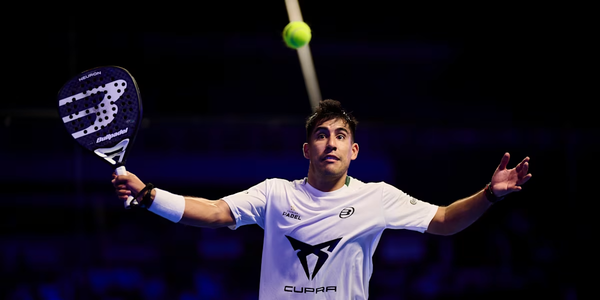
4. Bullpadel Neuron 02 — Medium-Hard
The most versatile racket on this list — which may seem like an odd entry in a power comparison, but is precisely what makes it worth including.
Extended Carbon faces over multi-EVA rubber. Medium-hard impact, balance toward the head but not excessively so, and a sweet spot that sits slightly lower on the face than you'd expect from an attacking racket. That lower sweet spot placement is what changes the equation: it keeps some control accessible even as you push toward more offensive play.
This is the racket Fede Chingotto uses on the right side — a nominally defensive position — which tells you something about how it manages the balance between aggression and reliability. It is an attacking racket. The balance is there. But it allows for defensive consistency that the harder options above it don't.
The rough finish is present but understated — slightly less pronounced than several competitors here, which is a genuine limitation if generating spin at the net is central to your game. The grip is thicker than others in this comparison, which suits some hands and not others; worth knowing if you prefer a thinner feel.
Best for: Advanced players who want attacking capability without fully sacrificing their baseline game. The most balanced option on this list for players who defend regularly and attack when the opportunity arrives.
[Check the full Padeldex breakdown →]
5. NOX EA10 Ventus Attack — Medium
The most accessible racket here, and the one that asks the least of you while still delivering genuine attacking performance.
12K Extreme carbon over Black Eva rubber — a medium-impact construction that allows the ball to dwell slightly longer on the face than the harder options above. That dwell time is the key difference: the ball is easier to direct, easier to control at the back of the court, and the contact feels more forgiving when your timing is slightly off.
The AT10 Attack format gives it the balance and overhead quality of an attacking racket — viboras carry depth without needing full swing input, volleys at medium pace have good weight behind them. The rough finish combines a lacquered rough texture with a sandy element, though it's less pronounced than the Triton or Barleón. The interchangeable cord is a positive.
The honest limitation: from the baseline at medium pace, the head tendency means you need to adjust your contact point, and the ball can float if you don't. The hybrid version of this racket — the EA10 standard — is the better daily-use option for most players. The AT10 Attack version is the choice when you specifically want more overhead punch.
Best for: Players stepping from a versatile racket into attacking territory for the first time, or advanced players who want attacking overhead performance with a more forgiving baseline character than the harder options.
[Check the full Padeldex breakdown →]
How to Choose Between Them
The honest framework is simple:
If you play in consistent heat and want the hardest possible response: Triton Power.
If you want seasonal flexibility and a durable, well-built frame: Varlion Bourne, summer or winter version depending on your conditions.
If you need attacking character but can't fully sacrifice the baseline: Neuron 02.
If you're entering attacking territory for the first time: EA10 Ventus Attack.
If you're an advanced player with good defensive fundamentals who wants a complete offensive weapon: Genius Attack 12K.
Climate matters as much as playing style here — harder rubber and colder temperatures are a difficult combination, and two of the five options above come with explicit seasonal recommendations. Factor that into your decision before the purchase, not after.
Browse each racket's full aggregated score breakdown on Padeldex to compare how they stack up across Power, Control, Maneuverability, Sweet Spot, and Roughness — across multiple independent reviewer sources.